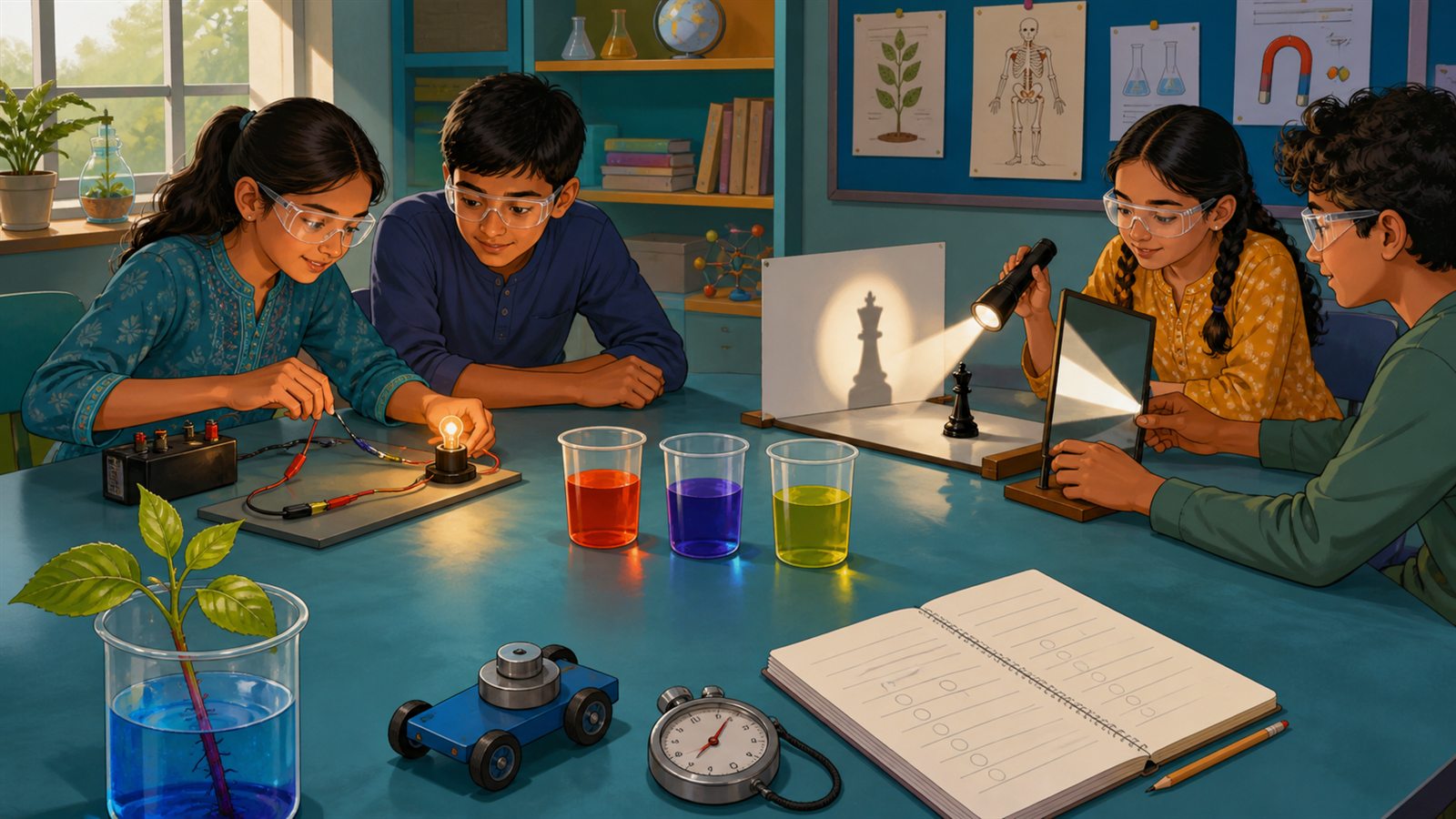
Build each idea from evidence: observe closely, model the hidden mechanism, investigate safely, repair a tempting misconception, and reason through a test sized to the chapter.
Section, tutorial, investigation, and test counts grow with the amount of reasoning each chapter needs.
⌕
Scientific inquiry · Chapter 1
The Ever-Evolving World of Science
Science is not a finished list of facts. It is a disciplined way to turn observations into testable questions, compare explanations with evidence, and revise ideas when better evidence appears. This chapter follows an investigation from curiosity to communication and shows why fair comparisons, repeatable measurements, and honest uncertainty make a claim trustworthy.
Distinguish an observation, inference, prediction, and testable question.
Identify variables and controls in a fair comparison.
Use repeated measurements and tables to judge patterns and uncertainty.
Build and revise a claim using evidence and scientific reasoning.
01
Observation is the starting record
An observation reports what a sense or measuring tool detects: a leaf is 8 cm long, a liquid turns pink, or a shadow moves. An inference proposes what might explain that record. Keeping the two separate prevents an early guess from being treated as a fact. Mechanism in focus: A measuring tool converts a property into a reading only when its scale, zero point, unit, and viewing position are used consistently. Recording the conditions makes a later comparison meaningful.
Connection: Careful observations create the data from which patterns, models, and new questions grow. Application: Weather stations, wildlife surveys, and medical records all depend on observations made with an agreed procedure so readings from different people and times can be compared. Misconception/safety check: An observation is not automatically reliable merely because it contains a number. A misaligned ruler, an uncalibrated sensor, or an unsafe use of smell can produce a precise-looking but poor record.
Inside this topic
Learn Observation is the starting record visually
Use the diagram, picture, or trusted explanation below as part of this lesson. Notice the relationship, then explain it in your own words.
Separate what is observed directly from the scientific claim each investigation could support.
◉
Look closely: Choose one investigation and name its changed variable, measured or observed outcome, and one condition to control.
Original teaching picture · reviewed for this lesson
02
Questions become testable through variables
A testable question names something that can be changed or compared and an outcome that can be measured. The independent variable is deliberately changed, the dependent variable is measured, and important control variables are kept alike. Mechanism in focus: A fair comparison isolates the proposed cause: planned groups differ in the independent variable, the dependent variable is measured the same way, and other influential conditions are controlled.
Connection: Variables turn broad curiosity into a fair plan that another person can repeat. Application: The same design logic supports crop trials, sports-equipment comparisons, and tests of insulating materials: change one feature while keeping the comparison conditions defensibly alike. Misconception/safety check: Changing wing length, paper mass, and release height together may create a difference, but it cannot show which change caused it. A control is a valid comparison condition, not necessarily “nothing.”
Inside this topic
Learn Questions become testable through variables visually
Use the diagram, picture, or trusted explanation below as part of this lesson. Notice the relationship, then explain it in your own words.
1 learning aid
▶
Trusted video explanation
The Ever-Evolving World of Science
Use a trusted visual explanation to check and extend the chapter model.
Look for this
Where an observation becomes an inference and then a testable claim.
Pause and predict: Pause before an explanation, make a prediction, and resume to compare it with the evidence shown.
Captions and access
Opens on the provider site. Use captions, playback speed, and transcript controls when available.
03
Measurements contain variation
Living things differ and instruments have limited precision, so repeated readings are rarely identical. Repetition, sensible units, and a table reveal whether a pattern is larger than ordinary variation. An unusual reading should be checked, not secretly removed. Mechanism in focus: Random variation scatters repeated readings in both directions, whereas a systematic error shifts them together. Repetition can reveal scatter, but checking calibration and method is needed to find bias.
Connection: Variation explains why scientists report ranges and uncertainty instead of pretending every number is exact. Application: Manufacturers examine variation in product dimensions, doctors compare repeated measurements, and ecologists sample many organisms because one value rarely represents an entire system. Misconception/safety check: An average does not repair a stopwatch that always starts late, and deleting an inconvenient result without a stated reason hides evidence. Report the range and any justified repeat openly.
04
Claims must be linked to evidence
A scientific explanation joins a claim to relevant evidence with reasoning. Evidence answers “What happened?” while reasoning answers “Why does that pattern support this claim?” A conclusion may support, weaken, or leave a claim undecided. Mechanism in focus: Reasoning must show why the observed pattern would be expected if the claim were sound and consider whether another cause could produce it. Causal claims need stronger controls than descriptions of association.
Connection: The claim–evidence–reasoning structure is useful throughout science, from circuits to ecosystems. Application: Evidence-linked claims guide choices about materials, health routines, and environmental action because readers can inspect what was measured and where the conclusion stops. Misconception/safety check: One successful trial does not prove a universal law, and “the data agree with my idea” is not reasoning. State limitations such as sample size, measurement uncertainty, and untested conditions.
Inside this topic
Learn Claims must be linked to evidence visually
Use the diagram, picture, or trusted explanation below as part of this lesson. Notice the relationship, then explain it in your own words.
1 learning aid
Interactive diagram
From a question to a defensible claim
Design a fair test and connect evidence to a limited claim.
Step 1 of 4
↳
Now explain the whole picture: Science improves explanations through a cycle in which evidence can support, limit, or revise a claim.
Read the complete diagram as text
Question: Name what can change and what can be measured.
Plan: Change one variable, control conditions, and repeat.
Measure: Record all observations, including variation.
Explain: Make a claim that fits the evidence and uncertainty.
Reveal the model one step at a time. Predict each next connection, then explain the complete model in your own words.